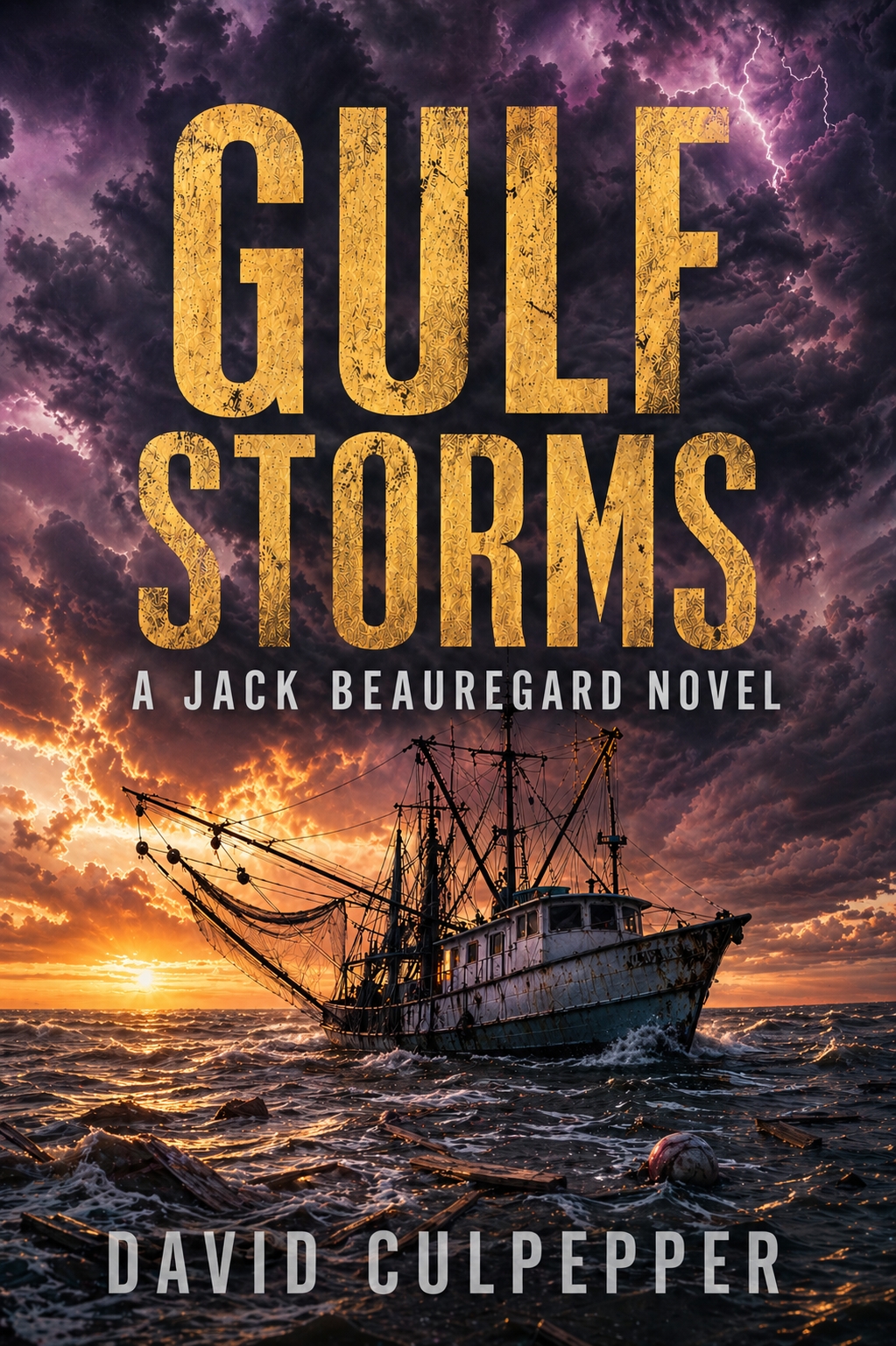
Book Two
Gulf Storms
The second Jack Beauregard thriller sends danger, secrets, and violence rolling toward the Gulf Coast.
A storm is building along the Gulf Coast, and U.S. Marshal Jack Beauregard is about to learn that some secrets do not stay buried just because the bodies do. As pressure rises and old violence pushes into the present, Jack is drawn into a case where loyalty, corruption, and survival collide under a sky dark enough to swallow the truth.
Book Description
About Gulf Storms
A storm is building along the Gulf Coast, and U.S. Marshal Jack Beauregard is about to learn that some secrets do not stay buried just because the bodies do. As pressure rises and old violence pushes into the present, Jack is drawn into a case where loyalty, corruption, and survival collide under a sky dark enough to swallow the truth.
Part of The Jack Beauregard Thrillers, a Southern noir thriller series set in Mississippi, where old sins do not stay buried and justice rarely comes clean.
Praise for Gulf Storms
“🏆 Booky Award Winner — Most Immersive Setting”
“Transforms the aftermath of a devastating hurricane into a riveting investigation.”
“Delivering atmospheric suspense that will keep readers hooked until the final page.”
“If you enjoy a crime thriller with a positive message of transformation and finding the truth, you will love Gulf Storms.”
“Atmospheric, character-driven, and steeped in Gulf Coast culture.”
Sample
Read a Sample
Sample Chapter
Chapter 1: After the Storm
Luke Reeves cut the throttle and let the twenty-five-foot response boat drift through murky, tan water.
Debris bumped past the hull: a child’s plastic pool, half a kitchen cabinet, something that might once have been a mailbox. A dead mullet floated belly-up near a broken cooler lid, its silver side catching the morning sun before the current rolled it under.
Luke checked the GPS coordinates against the morning patrol report.
Two hundred yards northeast.
The grounded vessel should be visible soon.
His uniform shirt stuck to his back beneath the orange life vest. September on the Gulf Coast, three weeks after Marlena, and the air still felt wet enough to drink. Nothing moved except the debris and the slow ripple spreading from the bow. Even the insects sounded tired.
He keyed his radio. “Station Gulfport, this is Response Boat One. I have visual on the reported vessel. Proceeding to investigate.”
“Copy, Response Boat One. Maintain radio contact.”
Luke eased forward.
The marsh grass parted, and there she was.
The shrimping boat sat canted to port, wedged deep in the cordgrass. Fifty feet, maybe fifty-two. White hull with blue trim, both buried beneath mud and algae. The outriggers hung wrong. Broken rigging trailed into the water. Nets twisted around the rails. The pilothouse windows were dark.
Vietnamese characters marked the hull.
Beneath them, in English: Hai Long.
Sea Dragon.
Luke brought the response boat alongside, killed the engine, and secured to the port rail with a spring line. The silence pressed in. No engine. No voices. No deckhands yelling over winches. No gulls fighting over scrap fish.
Just water touching fiberglass and wind moving through marsh grass.
He photographed the vessel from the response boat first. Bow. Stern. Port side. Starboard side where he could see it. Hull numbers. Registration marks. Name.
The boat’s name went into his notebook. Vietnamese registration numbers. List to port. Broken mast. Condition of the nets. Location relative to the channel. Weather. Tide. Time.
All of it fit a Category 2 hurricane.
Marlena had pushed an eight-foot surge through this part of the coast. Storm-force winds could drag a boat out of its slip, break lines, shove it through pilings, and leave it in a marsh miles from where it belonged. Luke had logged a dozen vessels like that since the storm.
That was the official expectation.
Storm damage. Recovery paperwork. Tow request. Insurance photograph.
He grabbed the rail and climbed on deck.
His boots squelched. Standing water filled the low spots. Torn plastic sheeting clung to a cleat. A cooler lay on its side with the lid missing. One rubber boot sat near the stern, heel crushed flat.
Luke paused and listened.
Nothing.
He started forward, waterproof camera in hand.
Railings bent. Equipment hung loose from its mounts. A diesel stain bloomed near the stern, black and rainbowed around the edges. Net floats rolled in a shallow puddle with each small shift of the hull.
Storm damage.
Then he saw the pilothouse.
Six small holes marked the fiberglass wall.
Too round.
Too clean.
The edges bent inward where something had punched through at speed.
Luke stopped.
His lower back had been aching all morning from climbing over wreckage and bending through flooded compartments. The ache vanished. The sweat under his vest no longer mattered.
The whole boat changed around him.
He moved closer without touching the wall and crouched. Star cracks spread from each hole. The grouping was tight, chest-high on a man standing inside.
Bullet holes.
Luke took three photographs before stepping any closer. Wide shot. Midrange. Close. He marked his position in the notebook and shifted left, keeping his boots away from broken glass and loose debris where he could.
The pilothouse door hung open.
He stepped inside.
Glass crunched beneath his boots.
The radio had been smashed. Not ripped loose by wind. Beaten. Plastic fragments littered the console. The microphone dangled by its coiled cord.
The GPS unit was gone.
Wires jutted from the dashboard where the mount should have been. Clean cuts. Pliers or a blade.
Luke photographed the bullet holes from inside, then the smashed radio, then the cut wires. His hands stayed steady.
His mouth went dry.
This was not hurricane damage.
A coffee mug lay on its side near the helm. Papers soaked and stuck to the deck. A laminated safety card curled at one corner. A rosary hung from a small hook near the windshield, dark beads swinging once when Luke brushed past the console.
He stopped and watched the beads until they went still.
Somebody had worked here. Prayed here. Hauled nets here. Cursed bad weather here.
Then somebody had fired through the wall.
Luke backed out of the pilothouse and worked aft.
Mosquitoes landed on his neck. He slapped them without looking away from the deck.
Near the stern, he found the blood.
The stain covered a patch roughly two feet wide, brown and flaked where it had dried. The deck texture showed through the mark. Luke crouched without touching it.
Too much for a cut hand.
The pattern looked pooled, not sprayed.
He photographed it from four angles. He placed an evidence scale beside it and photographed it again.
Scuff marks led from the blood patch to the port rail. Something heavy had been dragged. The marks crossed the deck, skipped where the fiberglass rose near a hatch lip, then continued to the side.
Over the rail.
Luke stood there and looked down.
The marsh water was opaque and still. It gave nothing back.
He made himself write.
Blood stain near stern. Approx. 24 inches at widest point. Drag marks from stain to port rail. Possible body movement.
Possible.
That was the word reports liked.
The deck did not feel possible.
It felt decided.
Luke swept the rest of the deck. More scuffs. Boots sliding. Bodies moving across wet fiberglass in ways that had nothing to do with work. One section of rail showed impact damage, wood splintered where something had struck hard.
He photographed all of it.
Then he turned to the cargo hold.
The hatch was secured but not dogged down tight. Luke photographed the latch, then opened it.
The hinges screamed.
Three feet of water covered the compartment below. Storm debris floated in it: broken boards, plastic bottles, rope, a bait bucket with no handle. The smell rose out first. Diesel. Dead fish. Brackish water.
And something chemical underneath.
Something that did not belong on a shrimping boat.
Luke waited a few seconds, breathing through his mouth, then descended the ladder. Water rose to his shins inside his rubber boots and spilled over the tops. Warm. Filthy. Thick with sediment stirred from the bottom.
Fishing equipment hung on the bulkheads. Ice chests bolted to the deck. Nets, rope, floats, spare gloves, plastic tubs. Everything expected.
In the aft section, beneath tangled net and torn plastic, he found six bundles.
Heavy plastic. Blue tape. Rectangular. Each about the size of a bread loaf. Empty now, collapsed but still holding its shape. Some had split seams. White residue dusted the inside where powder had once pressed tight against plastic.
Luke did not touch them at first.
He photographed the bundles where they lay. Wide. Midrange. Close. One bundle had a torn corner big enough for the residue to show. He moved the light closer and photographed that too.
The chemical bite reached him through diesel and fish rot.
Acrid. Artificial.
Close to something he remembered from interdiction training off the Florida coast.
Somebody had removed the product and left the skin behind.
He bagged each bundle separately. Location. Time. Seal. Mark. His hands worked through the routine.
Bag one.
Bag two.
Bag three.
The routine mattered. Routine kept men from rushing. Routine kept evidence from dying in court because some tired Coast Guard lieutenant let the scene get ahead of him.
Bag four.
Bag five.
Bag six.
Drug packaging.
Empty drug packaging.
The product was gone.
So was the crew.
Luke searched every compartment he could reach. Storage lockers. Sleeping quarters. The tiny head. Beneath bunks. Behind loose panels. No bodies. No personal effects in plain view except what the storm had not taken and the killers had not wanted.
He climbed back on deck and stood in the heat.
The marsh stretched away in all directions, green-brown grass bending in the breeze, water reflecting a hard blue sky. Other grounded boats sat in the distance. Debris everywhere. Marlena had broken the coast open and scattered its pieces across the water.
Someone had used the wreckage to hide a crime.
Luke keyed his radio.
“Station Gulfport, this is Response Boat One.”
“Go ahead, One.”
“I need supervisor response at my location. This vessel is a crime scene. Possible drug smuggling, evidence of violence, crew missing. Request federal law enforcement notification.”
Static filled three seconds.
“Copy that, Response Boat One. Stand by for Commander Riley. ETA twenty minutes.”
“Understood. I’m securing the scene. Response Boat One out.”
Luke clipped the radio to his vest and took out his notebook again.
Bullet count. Blood location. Bundle count. GPS coordinates. Water depth. Weather. Time: 10:47 AM.
His pen moved in neat block letters.
When this reached court, his notes would matter.
If anyone reached court.
He looked at the Vietnamese name on the hull. Hai Long. Sea Dragon. A family boat, most likely. Maybe three generations had worked her decks. Maybe somebody’s father had saved for ten years to buy her. Maybe sons had learned the water from that pilothouse before a gunman turned it into a box full of holes.
Point Cadet was full of families like that.
Families who had fled one war, crossed one ocean, and built lives on another stretch of dangerous water. Marlena had taken half of that in one night.
The blood on the deck told a different story.
Luke stood in the sun and waited.
Insects buzzed. Water lapped. Beyond the marsh, generators growled over Biloxi. FEMA trailers, debris piles, spray-painted search codes on houses. The coast was still counting its dead.
Somebody had used the noise to hide murder.
He uncapped his water bottle and drank. The water was warm enough to make him grimace, but he drank anyway. Three weeks of recovery sweeps had taught him that much.
A boat engine growled in the distance.
Luke moved to the rail.
Commander James Riley’s boat appeared through the debris field, picking its way along the marsh channel. Two people on it: Riley and Petty Officer Torres.
Riley came alongside and climbed onto the Hai Long with the slow care of a man who had spent most of his life on wet decks and knew better than to trust one. He was bigger than Luke, heavier, with gray hair under his hard hat and reading glasses hanging on a cord around his neck.
“Show me.”
Luke started with the pilothouse.
Six bullet holes. Smashed radio. Missing GPS. Cut wires.
Riley took his own photos, then followed Luke aft.
He crouched beside the blood.
“How much?”
“Enough to indicate significant injury. Pattern looks pooled, not spattered.”
Riley followed the drag marks to the rail and looked down into the marsh water.
“Crew?”
“No bodies. No personal effects in plain view. I checked all reachable compartments.”
“Below?”
Luke led him into the hold and showed him where the bundles had been.
“You moved them?”
“Photographed in place, then bagged and sealed. Six total. Blue tape. White residue inside. Chemical odor consistent with narcotics packaging.”
Riley stared at the empty space in the hold.
Water dripped somewhere behind them. Above deck, Torres crossed the pilothouse, his boots heavy on fiberglass.
“This happen during the hurricane?” Riley asked.
“Unknown. Bullet holes and blood could be from any point in the last three weeks. The storm may have provided cover. The boat could have been used before Marlena and caught in the surge, or somebody could have left it here afterward.”
“But you don’t think the storm abandoned it.”
“No, sir. The radio was beaten. The GPS was taken. Somebody cleaned this boat out after whatever happened here.”
Riley nodded once.
They climbed back to the deck.
The commander looked over the marsh, the grounded boats, the broken coastline beyond it. He had the face of a man adding trouble to a list already too long to finish.
“This goes federal,” Riley said. “FBI and DEA for sure. Customs too. Marshals if there’s corruption anywhere near it. Harrison County and Biloxi PD need to know.”
“Yes, sir.”
Riley keyed his radio.
“Station Gulfport, this is Commander Riley. I’m at Lieutenant Reeves’s location and confirm his assessment. Crime scene with evidence of drug smuggling, violence, and missing persons. Initiate federal notification. I want FBI and DEA contacted now. Loop in U.S. Marshals, Customs, Harrison County, and Biloxi PD. No one touches this boat until federal investigators arrive. Establish a security perimeter.”
“Copy, Commander. Initiating notifications now.”
Riley clipped the radio back to his vest and turned to Luke.
“The paperwork on this is going to be a nightmare. Get ready, Reeves. Your name is on the initial report.”
Luke looked at the blood on the deck, the bullet holes in the pilothouse, and the empty space in the hold where six bundles had been.
The missing crew was out there somewhere.
So were the men who had done this to them.
“It already is complicated, sir.”
Free Prequel Story
Start with Until I Get Out.
Join the reader list and get the free Jack Beauregard prequel story before stepping into the novels.
Get the Free StoryMore in the Series